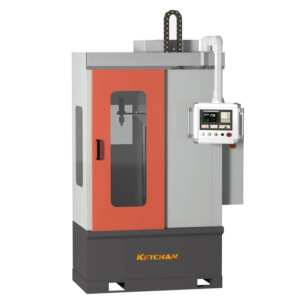
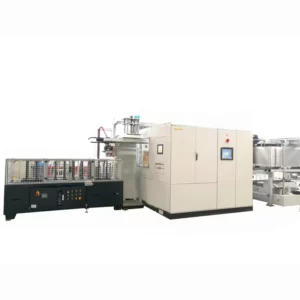
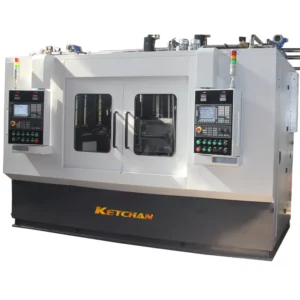
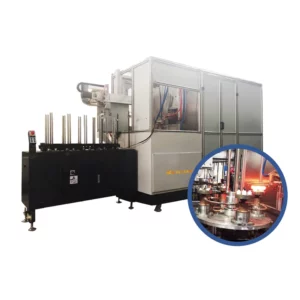
What is CV Joint Induction hardening system?
No. | Item name | Functions |
1 | HF induction heating machine | Output high frequency current, generally the frequency is 50~400kHz, selected according to the raceway diameter and depth. |
2 | Custom induction hardening coil | Closely following the arc surface of the raceway to ensure uniform heating (usually a ring-shaped or movable single-point tracking structure). |
3 | CNC hardening machine tool | Control the sensor to rotate or move synchronously along the inner raceway. |
4 | Cooling system | Rapid cooling (water spray or mist) to complete the martensitic transformation. |
5 | Workholding system | Fix the ball cage shell to ensure accurate positioning and smooth rotation. |
6 | Energy monitoring system | Precise control of temperature/power/time to achieve automated batch quenching. |
What is CV joint hardening method?
- Single-point scanning induction hardening: The induction coil moves along the raceway section by section to heat and harden.
- Integral annular induction hardening: The annular coil heats the entire raceway at once (suitable for small batches and efficient production);
- Dual frequency induction (sometimes used for complex contours) allows for consistent heating both at the surface and at depth.
How to choose the suitable CV joint induction hardening system?
Zhengzhou Ketchan Electronic Co., Ltd. has been focusing on the production of induction hardening systems in the automotive parts industry for more than 20 years. The CV Joint induction hardening system is a professional customized hardening system. Therefore, you can tell us the following content parameters, and our team can help you find a suitable hardening solution efficiently and quickly.
1). CV Joint ball cage raceway size, material, hardening layer depth, surface hardness, and production capacity requirements.
2). Provide samples/drawings for coil matching design.
3). We have a professional heat treatment processing center that can provide users with heat treatment quenching process tests for various ball cage parts to evaluate the hardening effect, efficiency, and deformation. Help users find a suitable hardening process.
4). Through the CV joint ball cage quenching heat treatment process experiment, the appropriate power supply power, frequency, cooling system, control method and other heat treatment parameters are obtained.
5). We will also share the video of the heat treatment process of the CV joint ball cage quenching we have done, and the slices after heat treatment hardening for users’ reference. Help users choose a suitable CV joint induction quenching system.

Why use induction for CV joint hardening ?
Using induction heating to quench CV Joints is one of the current mainstream and efficient heat treatment methods, mainly because it can meet the high requirements of CV raceways for strength, precision and wear resistance. The following are the specific reasons and advantages:
- Precise control of heating area
- The ball cage raceway only needs local surface hardening, and induction heating can accurately heat specific areas;
- It will not affect the entire ball cage structure and avoid excessive heat-affected zones.
- Small deformation and stable structure
- Fast induction heating speed → small thermal stress on the workpiece;
- Cooling immediately after heating → avoiding deformation and cracking caused by overall temperature rise.
- The hardening layer is uniform and controllable
- The hardening depth can be adjusted according to the frequency and power (commonly 1.2-2.5mm);
- Compared with flame heating or overall heat treatment, it is more suitable for parts with high requirements for raceway hardening.
- High surface hardness and good fatigue strength
- After quenching, martensite structure can be obtained, and the hardness can reach HRC 58~62;
- Effectively improve the wear resistance and contact fatigue life of the raceway.
- High efficiency and low energy consumption
- Induction heating can complete a quenching process within a few seconds to tens of seconds;
- High energy utilization rate (high efficiency of conversion from electric energy to thermal energy);
- Non-contact heating, no need to heat the entire cage, greatly saving energy and reducing consumption.
- Suitable for automation and mass production
- The sensing system is easy to integrate into the production line or robot loading and unloading system;
- Cooperate with visual recognition/manipulator to realize unmanned operation;
- Improve production capacity and improve product consistency.
- Environmentally friendly and safe
- No open flames or exhaust gas;
- No fuel gas (such as acetylene or natural gas) is required;
- The workshop is cleaner and safer.

Zhengzhou Ketchan Electronic CO., Ltd has been focusing on customized induction hardening systems for more than 20 years. We have a professional heat treatment team and a professional heat treatment processing center, focusing on solving various heat treatment problems for users. If you have heating treatment needs for ball cage quenching, contact us now to get a quote.